
National Forest Inventory
The National Forest Inventory (NFI) woodland map covers all forest and woodland areas over 0.5 hectare with a minimum of 20% canopy cover, or the potential to achieve it, and a minimum width of 20 metres. This includes new planting, clearfell, windblow and restock.
Data source: Forestry Commission
Data update schedule: Annually
Ancient Woodland
Ancient woodlands are classified as areas which have been wooded continuously since at least 1600 AD. This includes semi-natural woodland and plantations on ancient woodland sites. ‘Wooded continuously’ does not mean there is or has previously been continuous tree cover across the whole site, and not all trees within the woodland have to be old.
Data source: Natural England, Natural Resources Wales, Nature Scot
Data update schedule: Annually
National Trees Outside Woodland Map
The National Trees Outside Woodlands (TOW) map shows the location and extent of lone trees, groups of trees, and small woodlands derived from a number of datasets including LiDAR, satellite imagery and Ordnance Survey data. Each feature has information on height, area, and woodland type categorisation.
Canopy cover is categorised into the following woodland types -
- Lone trees - defined as 5m2 to 350m2 by size and only 1 or 2 trees
- Groups of trees - defined as 5m2 to 1,000m2 by size but with 2 or more trees
- Small woodlands - defined as greater than 1,000m2 by size only.
Data source: Forestry Commission
Data update schedule: Annually
Priority habitats Inventory
The Priority Habitat Inventory is a spatial dataset that maps priority habitats identified in the UK Biodiversity Action Plan and listed as being of principal importance for the purpose of conserving or enhancing biodiversity, under Section 41 of the Natural Environment and Rural Communities Act (2006).
There are 27 terrestrial and freshwater priority habitats mapped across England, as well as four habitat classes which are not priority habitats, but which hold potential importance for conservation of biodiversity in England.
Data source: Natural England
Data update schedule: Annually
Legend
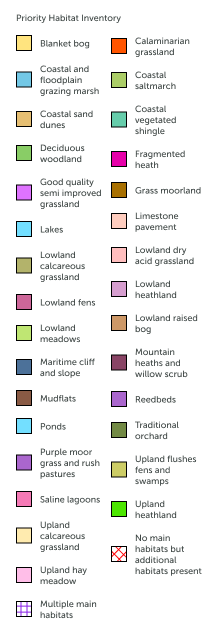
Priority habitats - Rivers
Maps rivers and streams that exhibit a high degree of naturalness. The naturalness classification used to map priority river habitat is based on recent work to review the river SSSI series. It evaluates four main components of habitat integrity: hydrological, physical, physico-chemical (water quality) and biological
Key elements are:
- a natural flow regime
- natural nutrient and sediment delivery regimes
- minimal physical modifications to the channel, banks and riparian zone
- natural longitudinal and lateral hydrological and biological connectivity
- an absence of non-native species
- low intensity fishery activities
Data source: Natural England
Data update schedule: Annually
Priority habitats - River headwater areas
One of the two datasets that make up the Priority River Habitat Map. Under the UK BAP definition all headwaters potentially form part of the priority habitat definition. The headwater resource can be a significant proportion of the river habitat.
Data source: Natural England
Data update schedule: Annually
Priority habitats - Lakes
Maps lakes in England that meet one or more priority habitat criteria. The priority habitat mapping is aimed at providing focus for preventing deterioration of the most natural remaining lakes in England.
Data source: Natural England
Data update schedule: Annually
Open Mosaic Habitats
This data refers to ecological mapping and survey information regarding highly biodiverse brownfield sites. These areas feature a complex, patchy mix of bare ground and early-stage vegetation. Open mosaic habitats can be extremely diverse, including such wide ranging sites as railway sidings, quarries, former industrial works, slag heap, bings and brick pits
Data source: Natural England
Data update schedule: Annually
Habitats Network - England
Habitat Networks - England is a spatial dataset that describes the geographic extent and location of Habitat Networks for 23 priority habitats based primarily, but not exclusively, on the priority habitat inventory with additional data added in relation to habitat restoration-creation, restorable habitat, plus fragmentation action, and network enhancement and expansion zones.
The Habitat Network Maps provide spatial guidance to plan and develop local ecological networks and may be used to help target action to build greater ecological resilience for habitats across England
The network zones are defined as:
- Network Enhancement Zone 1
- Land within close proximity to the existing habitat components that are more likely to be suitable for habitat re-creation for the particular habitat. These areas are primarily based on soils but in many cases have been refined by also using other data such as hydrology, altitude and proximity to the coast.
- Network Enhancement Zone 2
- Land within close proximity to the existing habitat components that are unlikely to be suitable for habitat re-creation but where other types of habitat may be created or land management may be enhanced including delivery of suitable Green Infrastructure.
- Fragmentation Action Zone
- Land immediately adjoining existing habitat patches that are small or have excessive edge to area ratio where habitat creation is likely to help reduce the effects of habitat fragmentation.
- Network Expansion Zone
- Land within relatively close proximity to the Network Enhancement Zones 1 & 2 that are more likely to be suitable for habitat creation for the particular habitat and identifying possible locations for connecting and linking up networks across a landscape.
Data source: Natural England
Data update schedule: Annually
Wood Pasture and Parkland
Maps the location and extent of Wood Pasture and Parkland habitat, that are Priority Habitats as listed in the UK Biodiversity Action Plan (UKBAP) 2008.
Wood pastures and parkland are the products of historic land management systems and designed landscapes and represent a vegetation structure rather than a particular plant community. Typically, this structure consists of large, open-grown or high forest trees (often pollards) at various densities, in a matrix of grazed grassland, heathland and/or woodland floras
Data source: Natural England
Data update schedule: Annually
Named Watercourse
This data is taken from Ordnance Survey’s National Geographic Database (NGD). The data has been further refined by only displaying records where the watercourse name is not null
Where a flow direction has been recorded as “In direction” we have been able to add an arrow onto the map to show which direction the name watercourse is flowing.
Data source: Ordnance Survey
Data update schedule: Quarterly
Unnamed Watercourse
This data is taken from Ordnance Survey’s National Geographic Database (NGD). The data is a network representation of the general alignment and connectivity of permanent water, including rivers, lakes, and canals. has been further refined by only displaying records where the watercourse name is null
Where a flow direction has been recorded as “In direction” we have been able to add an arrow onto the map to show which direction the name watercourse is flowing.
Data source: Ordnance Survey
Data update schedule: Quarterly
Other water features
This data is taken from Ordnance Survey’s National Geographic Database (NGD) and represents areas of permanent inland water such as ponds, lakes and reservoirs as polygon features. To be captured as a polygon, an area of permanent inland water generally has to have a minimum size of 8 sq m.
Data source: Ordnance Survey
Data update schedule: Quarterly
Living England Habitat Map Phase 4
This data is the output of The Living England project, led by Natural England, is a multi-year programme delivering a satellite-derived national habitat layer in support of the Environmental Land Management (ELM) System and the Natural Capital and Ecosystem Assessment (NCEA) Pilot.
The output habitat probability map displays modelled likely broad habitat classifications, trained on field surveys and earth observation data from 2021 as well as historic data layers.
There are 17 broad habitat classifications used in the data.
This data is only available on Groundsure Explorer, with a link provided in the PDF to view this data.
Data source: Natural England
Data update schedule: Annually